

Introduction
Waste is no longer only a cleanliness problem. It is also a resource, energy, cost, and climate challenge. Communities collect packaging, paper, metals, glass, food containers, and mixed rubbish every day, yet valuable materials are often lost because items enter the wrong bin or become contaminated.
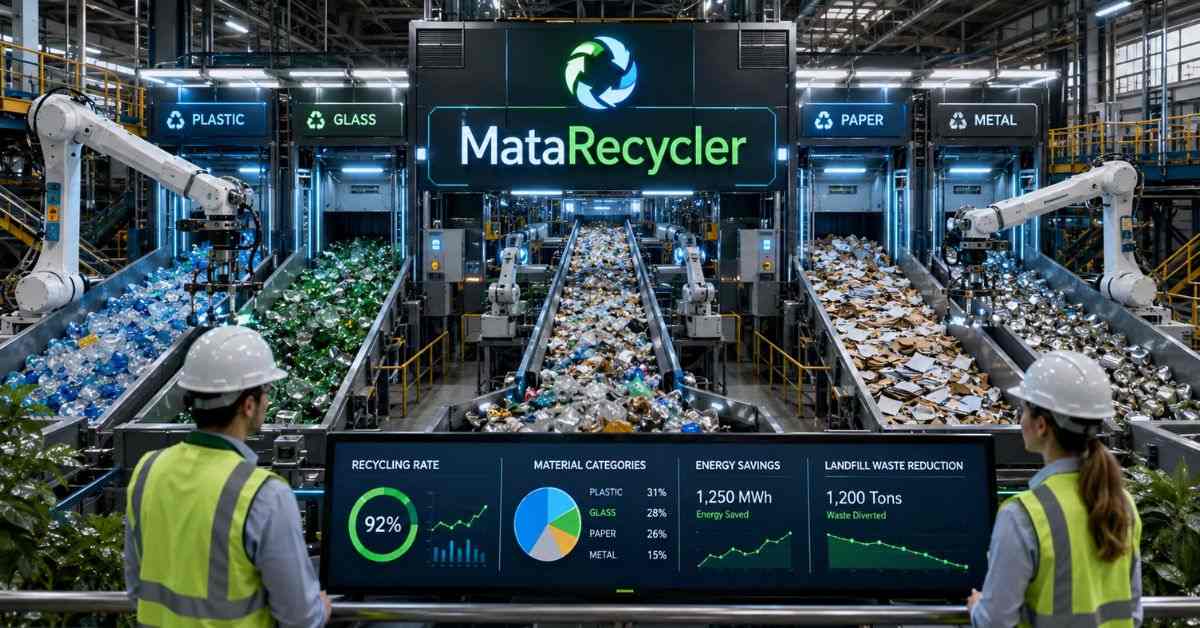
MataRecycler represents a response to this problem. Based on current descriptions, it combines artificial intelligence, smart sensors, automated sorting, and data tracking to identify waste and direct it toward recycling, composting, or disposal. Its public documentation remains limited, so it is best understood as an emerging smart-recycling model rather than a verified standard. The U.S. Environmental Protection Agency has supported similar machine-learning bins that classify waste at disposal.
This guide explains how the system could work, where it may create value, what limitations matter, and how communities can evaluate it responsibly.
What Is a MataRecycler?
MataRecycler is described as an AI-assisted waste management system that improves how recyclable materials are recognized, separated, and tracked. Instead of relying entirely on people to understand local rules, it may use cameras, weight sensors, material scanners, and machine-learning software to examine discarded items.
Its main goals are to:
- Separate recyclables from general waste
- Reduce contamination caused by incorrect disposal
- Record collected material types and quantities
- Improve bin placement and collection schedules
- Support circular-economy planning with better data
The idea fits a wider shift from simple waste collection toward resource recovery. European waste policy prioritizes prevention, reuse, recycling, recovery, and disposal in that order.
Why Smarter Waste Sorting Is Needed
Traditional recycling depends heavily on correct decisions in homes, offices, schools, and public spaces. A contaminated load may contain food residue, plastic bags, liquids, batteries, or materials that a local facility cannot process. These mistakes raise costs and reduce the quality of recovered material.
Smart sorting can address several weaknesses
- Recycling rules vary between cities
- People may not recognize packaging types
- Overflowing bins create litter and inefficient collection
- Manual sorting can be repetitive and hazardous
- Operators often lack real-time waste data
The EPA estimates that upgrading U.S. recycling facilities with improved sorting equipment would require major investment.
How the AI Sorting Process Could Work
A typical MataRecycler process would begin when someone places an item into a smart bin or onto a sorting line. Sensors capture information, while software compares the object with patterns learned from labeled images and material data.
A simplified workflow
- A camera records the item’s shape, color, label, and surface.
- Weight, infrared, metal, or moisture sensors collect extra signals.
- A machine-learning model predicts the material category.
- A gate or robotic arm directs the item to the correct stream.
- The result is stored for reporting and future improvement.
- Uncertain items are flagged for human review.
This model is realistic. EPA-supported TrashBot uses machine learning and cloud storage to identify discarded objects and send them into recycling, compost, or landfill compartments.
Core Technologies Behind the System
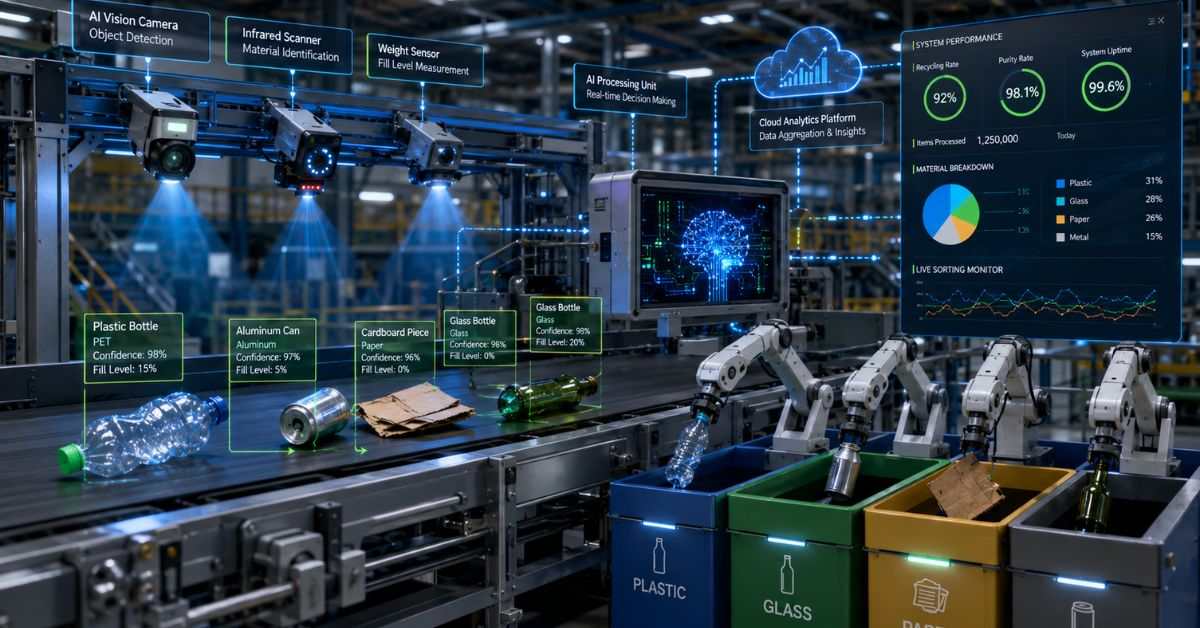
MataRecycler would rely on several connected technologies rather than one “magic” AI model.
| Technology | Main Role | Practical Value |
| Computer vision | Recognizes objects and packaging | Fast identification |
| Smart sensors | Detect weight, metal, moisture, or fill level | Better classification |
| Machine learning | Improves predictions from past examples | Adapts to new waste |
| Robotics or gates | Separates materials physically | Reduces repetitive work |
| Cloud analytics | Stores operational data | Supports planning |
| User interface | Shows guidance and status | Improves participation |
The strongest design would combine automation with human oversight. Operators should be able to review errors, update accepted-material lists, and retrain models when packaging changes.
Environmental and Energy Benefits
The value of MataRecycler depends on whether it produces cleaner material streams and sends fewer recoverable items to landfill. Better separation may increase the supply of secondary materials used in manufacturing.
Potential benefits include
- Less recyclable material buried or burned
- Lower contamination in paper, metal, glass, and plastic
- More reliable feedstock for processing facilities
- Fewer unnecessary collection trips through fill monitoring
- Better evidence for waste-reduction programs
- Greater public awareness of correct disposal
Recycling can save energy because processing secondary material often requires less energy than producing material from new resources. A U.S. Department of Energy resource notes that recycled aluminum production can use about 5% of the energy required to make aluminum from ore.
MataRecycler Versus Conventional Recycling
The comparison below shows how AI-assisted sorting may differ from ordinary bins.
| Area | Conventional Approach | AI-Assisted Approach |
| Identification | User chooses a bin | Sensors classify the item |
| Contamination | Errors are found later | Some errors are stopped early |
| Collection | Fixed schedules | Fill data can guide routes |
| Reporting | Periodic audits | Continuous digital records |
| Updates | New signs and training | Models and databases are updated |
| Human role | Disposal and sorting | Oversight and exception handling |
MataRecycler would not remove the need for workers. It would shift their responsibilities toward quality control, maintenance, safety, data review, and public education.
Uses in Communities, Schools, and Businesses
A flexible MataRecycler system could be useful wherever waste volumes are high or contamination is expensive.
Possible locations include
- Apartment buildings
- Schools and universities
- Shopping centers, airports, and stadiums
- Hospitals and offices
- Factories and warehouses
- Municipal recycling centers
The system could display disposal guidance, measure participation, and identify locations needing clearer signs. Dashboards may reveal packaging waste, collection costs, and missed opportunities, while city data can guide education campaigns without unnecessary personal information.
Schools could use the system to teach students about material recovery and responsible consumption. Businesses could study which products create the most waste, while municipalities could use collection data to improve recycling campaigns and reduce overflowing containers.
Real-World Examples Supporting the Concept
Verified MataRecycler performance data is not publicly established, but related projects show how AI can improve waste operations.
Smart-bin example: CleanRobotics developed TrashBot to sort items into recycling, compost, and landfill streams. The EPA supported the technology through its small-business innovation program.
Waste-audit example: Zabble Zero uses AI to analyze photographs for bin fullness and contamination. The EPA reported that clients measured more than 15,000 tons of material and prevented over 100 tons from going to landfill during the reported 2022 period.
These examples do not prove MataRecycler’s results, but they show that computer vision, automated classification, and waste analytics are practical tools. They also demonstrate why organizations should test performance through controlled pilot programs before investing in large installations.
Challenges, Risks, and Trust Factors
Smart recycling must be evaluated carefully. An inaccurate system may send useful material to landfill or contaminate a clean stream. Cameras and cloud platforms can also create privacy and cybersecurity concerns.
Decision-makers should examine
- Independently measured sorting accuracy
- Performance with dirty or crushed items
- Compatibility with local recycling rules
- Data ownership, retention, encryption, and access
- Maintenance costs and replacement parts
- Manual override and shutdown procedures
- Safe handling of batteries, chemicals, and sharp objects
Claims such as “zero waste” or “perfect accuracy” deserve caution unless supported by transparent testing. Trust grows through published methods, pilot results, clear limitations, and responsible data governance.
Local recycling facilities must also be consulted. An item identified as technically recyclable may still be rejected if nearby processors lack the equipment or market needed to handle it.
How to Plan a Responsible Deployment
A successful MataRecycler project should begin with a pilot rather than an immediate citywide purchase. The goal is to test real waste, users, and facility requirements.
A practical rollout can follow these steps
- Audit the current waste stream and contamination rate
- Select one controlled site
- Define accepted materials with the local processor
- Set targets for recovery, purity, uptime, and cost
- Train staff and provide simple instructions
- Compare AI decisions with human audits
- Review privacy, safety, and cybersecurity controls
- Expand only when benefits exceed operating costs
The technology should support waste prevention and reuse, not encourage greater consumption simply because sorting becomes easier. Organizations should publish pilot findings clearly, including mistakes and limitations, so decision-makers can judge whether the system offers genuine value.
FAQs
Is MataRecycler a software platform or a robot?
It may include both. The concept combines AI software, sensors, data tools, and physical sorting equipment.
Can MataRecycler recognize every recyclable item?
No. Accuracy depends on training data, sensor quality, local rules, packaging condition, and maintenance.
Does it replace normal recycling bins?
It could replace selected bins or add smart identification to existing collection points. Large facilities may use it on conveyor lines.
Can small communities use MataRecycler?
Yes, but a shared pilot or limited installation may be more affordable than a full network. Communities should compare installation costs with expected savings.
Is user data collected?
A responsible system should collect only operational data needed for sorting and planning. Camera or account features require clear privacy rules.
Conclusion
MataRecycler presents a useful vision for future waste management: sensors, machine learning, automation, and data helping people separate materials more accurately. Its potential value lies in cleaner recycling streams, lower contamination, smarter collection, stronger reporting, and better recovery of resources that might otherwise be lost.
Technology alone, however, cannot solve the waste problem. Communities still need sensible packaging rules, public education, reliable recycling markets, safe facilities, and a strong focus on reducing and reusing materials before disposal. Because public evidence about MataRecycler itself remains limited, buyers and authorities should request pilot data, independent accuracy testing, privacy safeguards, maintenance plans, and proof of compatibility with local processors.
The best next step is to identify the most costly local sorting problem and test whether an AI-assisted system can solve it with measurable environmental and financial results.