

Introduction
Energy costs are rising, connected devices are multiplying, and many people still receive a monthly bill with little explanation of where their electricity went. Wattip offers a useful way to solve that problem. In this guide, the term describes a smart energy-monitoring approach that collects usage data, turns it into clear insights, and helps users reduce waste across homes, businesses, solar systems, batteries, and Internet of Things devices.
No widely recognized official product specification or established manufacturer for Wattip could be confirmed through authoritative sources. Current online references mainly present it as an emerging energy-management concept. This article therefore explains the technology it represents rather than making unsupported claims about a particular brand. The idea closely matches established energy management information systems, which the U.S. Department of Energy describes as software tools that monitor, analyze, and sometimes control building energy use.
By the end, you will understand how the system may work, where it adds value, and what to check before installation.
What Is Wattip?
Wattip can be understood as a digital energy-management layer between electrical equipment and the person responsible for controlling it. Instead of showing only total monthly consumption, it organizes energy data by time, circuit, device, location, or source.
A practical setup may help users
- View live or near-real-time electricity demand.
- Compare daily, weekly, and monthly patterns.
- Identify unusually high loads.
- Estimate costs using tariff information.
- Track solar generation, batteries, and grid imports.
- Receive alerts when usage crosses a limit.
This model resembles an energy management information system, combining devices, data services, analytics, and software to improve building performance.
How the Technology Works
A Wattip-style system turns electrical measurements into decisions. Sensors or compatible meters collect readings, a gateway transfers them, and software converts raw numbers into charts, alerts, forecasts, or automated actions.
| System layer | Main role | Typical output |
| Sensors and meters | Measure electricity use | Live readings |
| Gateway or hub | Connect equipment to software | Secure data transfer |
| Analytics platform | Find trends and unusual behavior | Reports and recommendations |
| Control layer | Apply schedules or rules | Device switching |
| User dashboard | Present information clearly | Mobile or web insights |
Some systems use individual smart plugs, while others analyze whole-building demand. The best design depends on accuracy needs, electrical layout, network quality, and compatibility. Smart meters may also support two-way communication, time-based pricing, and demand response.
Wattip for Smarter Homes
In a home, the strongest benefit is visibility. A household may know that its bill increased but not whether air conditioning, water heating, an old refrigerator, vehicle charging, or standby power caused it.
Useful applications include
- Setting a daily electricity budget.
- Comparing weekday and weekend demand.
- Detecting devices that run too long.
- Scheduling heavy appliances for off-peak hours.
- Linking occupancy sensors with lighting or cooling.
- Measuring the effect of efficiency upgrades.
Start with a few meaningful alerts, such as an unexpected overnight load. Home automation can then apply schedules and sensor-based rules through a phone, tablet, or in-home display.
Business and Commercial Uses
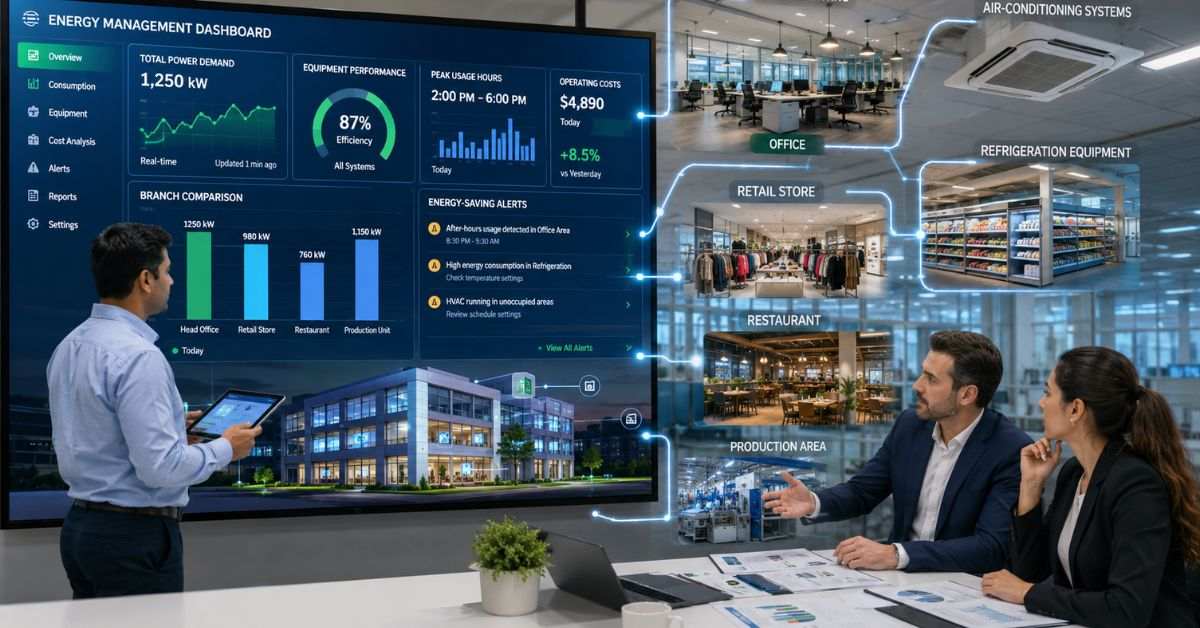
Businesses need to know which site, process, or operating period caused an energy cost. Wattip can organize performance around operational goals.
A shop, office, restaurant, school, or small factory could use it to:
- Compare energy use across branches.
- Find equipment running after closing.
- Track cooling, lighting, and refrigeration.
- Detects sudden load changes.
- Measure results after maintenance.
- Create reports for managers.
Energy data becomes more useful when combined with business context. A restaurant may compare electricity with opening hours, while a manufacturer may compare it with production output. DOE guidance describes commercial energy-management systems as tools for monitoring, analytics, fault detection, benchmarking, and control.
Solar Panels, Batteries, and Grid Power
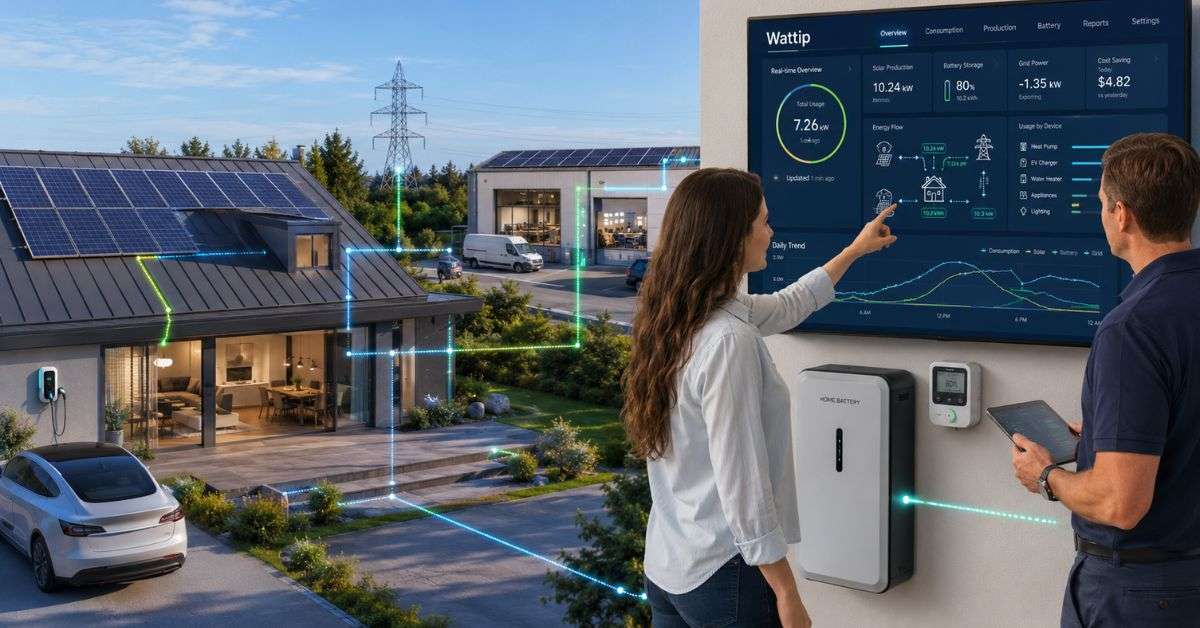
Solar owners need to know how much energy was produced, used directly, stored, imported, or exported. Wattip can bring these flows into one dashboard.
A solar view may display
- Current and historical panel output.
- Home or business consumption.
- Battery state of charge.
- Grid imports and exports.
- Solar self-consumption.
- Expected versus actual production.
This information can help users move water heating or vehicle charging into sunny periods. It may also reveal declining output that needs inspection. DOE notes that energy-management platforms can monitor photovoltaic systems and compare production with expected performance or local solar conditions.
Connected Devices and Automation
Monitoring shows what happened; automation helps users respond. Wattip can act as a decision layer for thermostats, smart plugs, lighting, vehicle chargers, water heaters, and selected business equipment.
Possible rules include
- Reduce cooling when a building is empty.
- Pause nonessential loads during a peak.
- Charge a battery when solar output is high.
- Delay an appliance until electricity is cheaper.
- Alert staff when equipment behavior changes.
- Turn off forgotten devices after business hours.
Every system needs manual controls and safe limits. Medical equipment, refrigeration, safety systems, and critical processes should never be interrupted for minor savings. Smart controls should balance efficiency with comfort and operational needs.
Potential Savings and Waste Reduction
Wattip does not create savings automatically. Value comes from actions taken after patterns are identified, such as changing schedules, repairing faults, adjusting settings, or replacing inefficient equipment.
An IEA example from a smart neighborhood in Alabama reported energy savings of 35% to 45% compared with similar homes. However, those results came from a combination of efficient construction, smart controls, solar, and microgrid coordination not monitoring alone. Results elsewhere will vary.
| Scenario | Data finding | Practical response | Possible value |
| Home | High overnight load | Check standby devices | Less wasted power |
| Retail shop | Cooling after closing | Correct schedules | Lower operating cost |
| Solar home | Low daytime self-use | Move flexible loads | Better solar value |
| Small factory | Motor load increases | Inspect equipment | Earlier maintenance |
| Multi-site firm | One branch uses more | Compare settings | Better benchmarking |
These examples are illustrative, not guaranteed outcomes.
Data Privacy and Cybersecurity
Energy data can reveal occupancy patterns, operating hours, and device behavior, so privacy must be designed into the system. A cheap monitor with weak security may create more risk than value.
Before adopting Wattip, check for:
- Encryption in transit and storage.
- Multi-factor authentication.
- Clear data ownership and deletion rules.
- Regular software and firmware updates.
- Role-based employee access.
- Local operation during cloud outages.
- A vulnerability-reporting process.
NIST recommends planning before buying connected devices, enabling authentication, applying updates, and reviewing privacy choices. It also publishes specific guidance for connected energy resources such as smart inverters.
How to Choose and Implement Wattip
Begin with a problem, not a dashboard. Decide whether the goal is bill control, solar optimization, maintenance, carbon reporting, or peak-demand reduction. Then choose the smallest setup that can measure the result.
A sensible rollout includes
- Record several weeks of baseline use.
- List the circuits or devices that matter.
- Confirm meter, inverter, battery, and network compatibility.
- Use a qualified electrician for panel installation.
- Configure tariffs and alerts carefully.
- Check readings against utility bills.
- Review results monthly.
- Add automation only after monitoring is reliable.
Your utility may already provide interval data through a customer portal. The DOE’s Green Button initiative, for example, supports secure customer access to detailed energy information in a standardized format.
FAQs
Is Wattip a smart meter?
Not exactly. A smart meter measures consumption, while the platform is better understood as the analytics and control layer that may use meter data.
Can Wattip lower an electricity bill?
It can reveal waste and support better schedules, maintenance, and automation. Savings depend on the building, tariff, equipment, behavior, and actions taken.
Does it work with solar panels?
A compatible setup can track production, consumption, battery activity, and grid exchange. Inverter and meter compatibility must be confirmed.
Is Wattip suitable for businesses?
Yes. The concept can scale from one small site to multiple buildings, especially when energy use is compared with operating hours or production.
Is energy-monitoring data private?
It should be treated as sensitive. Use strong authentication, encryption, controlled access, clear data policies, and devices that receive security updates.
Conclusion
The concept represents a shift from receiving an unexplained electricity bill to understanding how energy moves through a property. By combining meters, sensors, analytics, alerts, and carefully designed automation, it can help households and organizations find waste, improve solar self-consumption, manage peak demand, and detect unusual equipment behavior.
Its value depends on accurate measurement and disciplined use. The smartest starting point is not a large collection of devices but a clear goal, a trustworthy baseline, and a small number of measurable actions. Security, compatibility, electrical safety, and data ownership should be evaluated before installation.
Useful related internal articles could cover smart meters, home automation, solar battery storage, energy-efficient appliances, and IoT cybersecurity. By connecting those topics with real usage data, Wattip can become more than another dashboard—it can support better daily decisions and a more efficient energy system.