

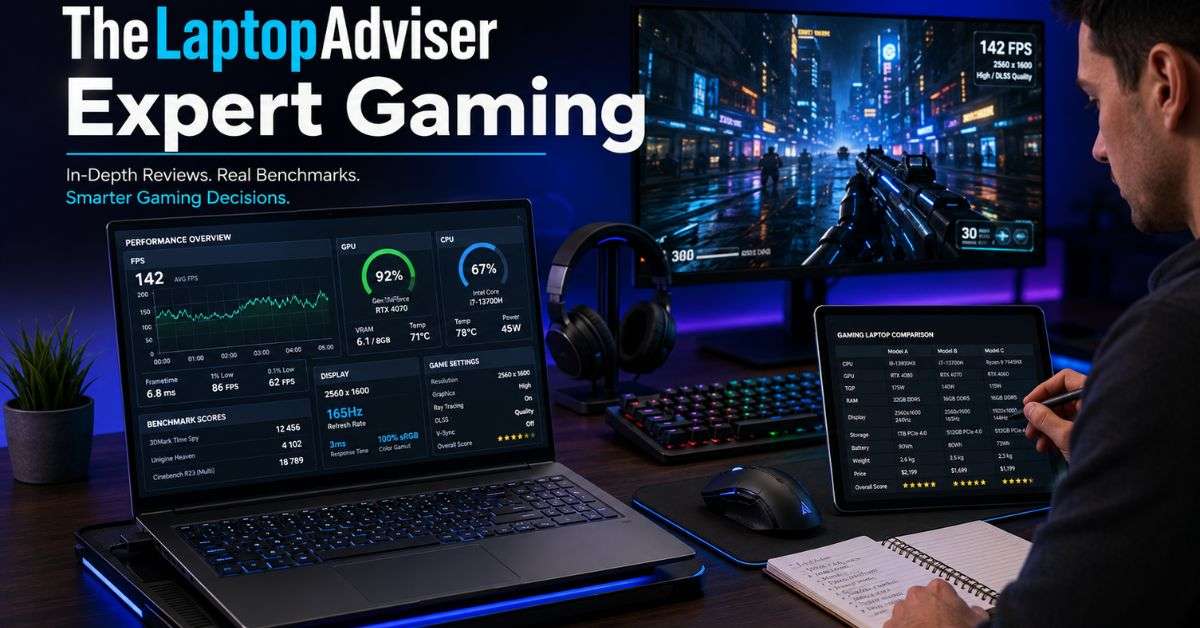
Introduction
Gaming laptops can now run esports, open-world games, streaming software, and creative applications. Yet buying the right model remains difficult. Product pages often highlight processor names and graphics chips without explaining temperatures, power limits, display quality, or upgrade options.
TheLaptopAdviser expert gaming guidance helps readers judge the complete machine rather than one impressive feature. It connects hardware with practical results such as smoother gameplay, quicker loading, better image quality, and stable long-session performance.
This guide explains how to compare gaming laptops, select components, understand reviews, improve performance, and avoid poor-value purchases. By following TheLaptopAdviser expert gaming principles, buyers can choose a balanced system for their games, budget, and future needs.
What Is TheLaptopAdviser Expert Gaming?
TheLaptopAdviser expert gaming refers to practical laptop reviews, component explanations, benchmark guidance, and buying advice for gamers. It makes complicated hardware easier to understand by linking specifications with everyday use.
Useful guidance examines
- Graphics and processor performance
- RAM, storage, and upgrades
- Display resolution and refresh rate
- Cooling, fan noise, and sustained speed
- Keyboard quality, ports, and portability
- Battery life and overall value
The main idea is balance. A powerful graphics chip can be limited by poor cooling, while a premium screen offers little value when the laptop cannot produce enough frames. Reliable guidance recommends the right combination for each user.
How Gaming Laptops Should Be Reviewed
A proper review should test a laptop under realistic conditions. Short benchmarks may show peak speed, but longer tests reveal heat, frame-rate drops, and fan behavior. TheLaptopAdviser expert gaming analysis should therefore evaluate both performance and usability. A complete review considers:
- Average and one-percent-low frame rates
- CPU and GPU temperatures
- Noise in different power modes
- Screen brightness, color, and response time
- Keyboard comfort and ports
- Battery life, SSD speed, and upgrade access
Testing details must be clear because resolution, graphics settings, drivers, power mode, and charger use can change results. Honest reviews also mention weaknesses such as dim screens or limited storage.
Choosing the Right Graphics Processor
The GPU usually has the greatest effect on frame rate and visual quality. It handles textures, lighting, shadows, ray tracing, and image rendering. Therefore, TheLaptopAdviser expert gaming recommendations often start with graphics performance.
GPU names alone are not enough. Similar chips may use different power levels, and stronger cooling can improve sustained speed.
| Gaming purpose | Suitable GPU level | Typical target |
| Older and casual games | Entry-level dedicated graphics | 1080p, low to medium |
| Esports | Entry or mid-range graphics | 1080p, high frame rates |
| Modern AAA games | Mid-range graphics | 1080p or 1440p |
| Premium visuals | Upper-mid-range or high-end graphics | 1440p with upscaling |
The type of game, resolution, video memory, cooling, and power limitations should all be taken into account by buyers. The best GPU meets a realistic goal without unnecessary spending.
Understanding the CPU, RAM, and Storage
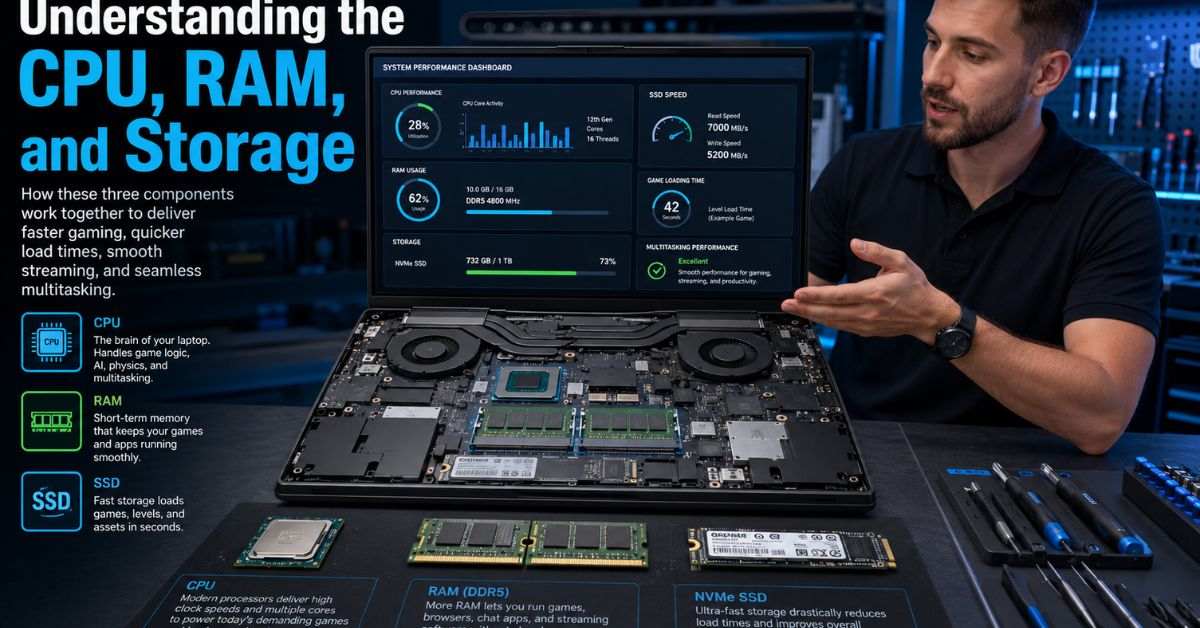
A balanced laptop also needs a capable CPU, enough memory, and fast storage. TheLaptopAdviser expert gaming advice treats these parts as one connected system.
The CPU manages game logic, physics, artificial intelligence, background software, and high-frame-rate workloads. For most buyers, 16GB of RAM is a sensible starting point. A 32GB configuration is useful for streaming, editing, simulation games, or heavy multitasking.
Modern games require substantial storage, so a 1TB NVMe SSD is often practical. Buyers should also check for replaceable RAM and a second SSD slot.
Display Quality, Refresh Rate, and Resolution
The display shapes every gaming session, so TheLaptopAdviser expert gaming comparisons should look beyond resolution. A fast laptop can still feel disappointing when its screen is dim, blurry, or slow.
Important features include
- Resolution and aspect ratio
- Refresh rate
- Pixel response time
- Brightness and contrast
- Color coverage
- Adaptive synchronization
A 144Hz or 165Hz panel suits many users, while 240Hz can benefit serious esports players. Higher resolution looks sharper but increases GPU workload, so the display and graphics hardware should be matched carefully.
Cooling and Sustained Gaming Performance
Cooling determines whether a laptop can maintain its advertised speed. Excessive heat may reduce clock speeds and cause frame drops. TheLaptopAdviser expert gaming reviews should test long sessions rather than only quick benchmarks.
Buyers should examine ventilation, chassis thickness, exhaust placement, surface temperatures, and noise. They can also improve airflow by:
- Using a hard, flat surface
- Keeping vents uncovered
- Cleaning visible dust carefully
- Closing unnecessary programs
- Using the correct charger
- Selecting a suitable performance profile
Thin laptops are portable, but larger models often provide more cooling space. The right choice depends on whether mobility or maximum sustained performance matters more.
Selecting a Laptop for Your Gaming Style
Different users need different features. TheLaptopAdviser expert gaming guidance is most useful when it matches hardware with gaming habits.
| User type | Main priorities |
| Casual gamer | Value and reliable 1080p performance |
| Esports player | High refresh rate and strong CPU |
| AAA gamer | Strong GPU, cooling, and video memory |
| Student gamer | Portability, quiet mode, and battery life |
| Streamer | Strong CPU/GPU, more RAM, useful ports |
| Creator-gamer | Accurate display, storage, acceleration |
Imagine two similarly priced laptops. One has a stronger GPU but weak cooling and a dim screen. The other has a slightly lower GPU tier, better cooling, 1TB storage, and upgradeable memory. The second may offer a better daily experience.
Gaming Performance Tips After Purchase
Correct setup can improve smoothness, temperature, and stability. TheLaptopAdviser expert gaming tips should prioritize safe changes instead of risky tuning.
Useful steps include
- Install official graphics drivers
- Enable Windows Game Mode
- Use a balanced or performance profile
- Confirm games use the dedicated GPU
- Close unnecessary apps
- Keep free SSD space
- Adjust shadows, ray tracing, and textures
- Use supported upscaling
- Limit frame rate to reduce heat
Avoid unofficial drivers, random booster apps, unsafe registry edits, and aggressive overclocking. Consistent performance and hardware safety matter more than a small temporary benchmark increase.
How to Identify Trustworthy Gaming Advice
Not every online guide is based on direct testing. Some repeat marketing claims without measuring performance. Readers using TheLaptopAdviser expert gaming information should check whether the evidence is transparent.
A trustworthy review explains
- Which games and settings were tested
- How long testing continued
- Which power profile was used
- Whether results were measured
- How battery and display tests were performed
- What disadvantages were found
- Whether sponsorships are involved
- When the content was updated
Good advice separates manufacturer claims from independent findings and considers professional tests, owner experiences, warranty coverage, and return conditions.
FAQs
Is TheLaptopAdviser Expert Gaming Helpful for Beginners?
Yes. TheLaptopAdviser expert gaming helps beginners connect terms such as GPU power, refresh rate, RAM, SSD, and thermal throttling with real gaming results.
How Much RAM Is Necessary for a Gaming Laptop?
Most players should begin with 16GB. A 32GB setup is better for streaming, professional editing, extensive multitasking, simulation games, or long-term flexibility.
Is a High-Refresh-Rate Screen Always Better?
It is most useful when the laptop produces high frame rates. Brightness, response time, color quality, and resolution remain important.
Can a Gaming Laptop Be Used for Work or Study?
Yes. It can handle office work, programming, design, and editing. However, weight, charger size, noise, battery life, and webcam quality should be considered.
Should I Buy the Most Expensive Gaming Laptop?
No. TheLaptopAdviser expert gaming favors balanced value. A well-cooled mid-range laptop with a good screen and upgradeable storage may be more useful than a costly model with features you rarely need.
Conclusion
Choosing a gaming laptop becomes easier when every major component is considered together. The GPU matters, but the CPU, RAM, storage, display, cooling, keyboard, ports, battery behavior, and upgrades also shape the experience.
TheLaptopAdviser expert gaming guidance helps buyers move beyond marketing and focus on measurable performance. Before purchasing, compare independent reviews, confirm the exact configuration, study long-session temperatures, and check warranty and return terms. Consider your games, preferred resolution, and need for portability, streaming, study, or creative work.
After purchase, use official drivers, maintain clear airflow, choose sensible graphics settings, and monitor performance when problems appear. By applying TheLaptopAdviser expert gaming advice, gamers can select a reliable laptop that delivers stable speed, suitable visuals, enough storage, and strong long-term value.