

Introduction
Geometry education is no longer limited to textbooks, rulers, and chalkboard diagrams. In today’s digital learning environment, students expect interactive experiences that help them visualize and understand complex mathematical ideas. This shift has led to the development of Geometry Learn V3, the third major evolution of digital geometry curriculums.
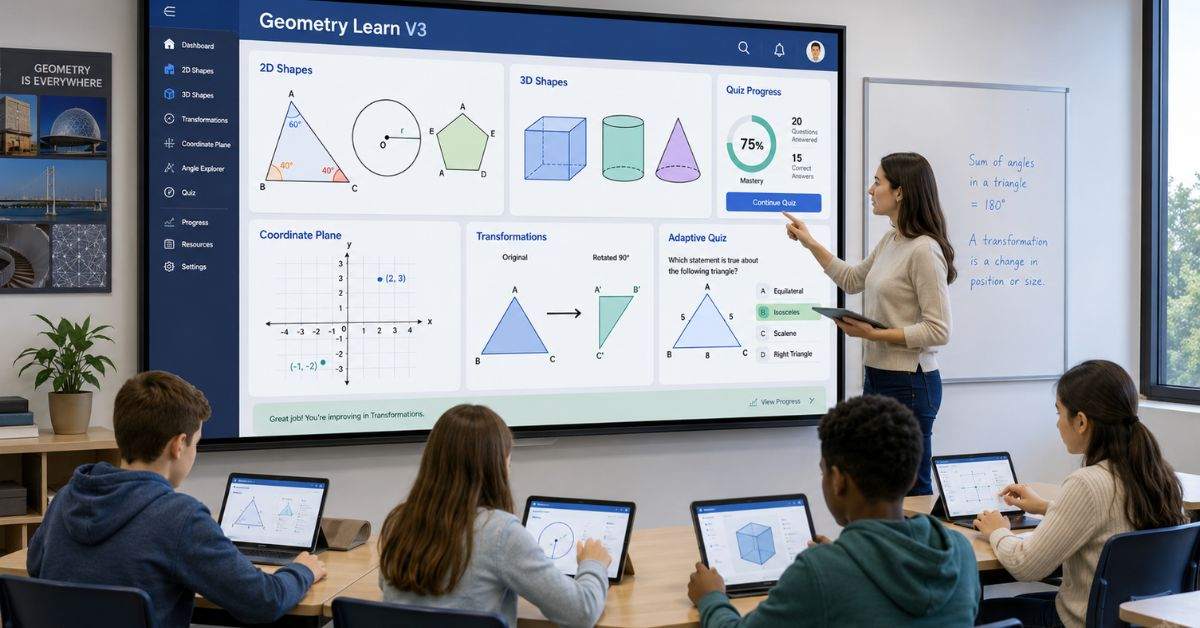
Geometry Learn V3 refers to an advanced, interactive framework designed to help students master shapes, angles, transformations, and spatial reasoning through technology-driven instruction. Unlike earlier versions, it emphasizes dynamic modeling, real-time feedback, and adaptive learning pathways. The goal is not just to solve problems but to deeply understand geometric logic.
In this comprehensive guide, you will explore how Geometry Learn V3 works, what makes it different, its benefits for students and educators, and how it prepares learners for STEM success. Whether you are a teacher, parent, administrator, or student, this article will give you a complete and practical understanding of Geometry Learn V3 and why it represents the future of geometry education.
What Does Geometry Learn V3?
Geometry Learn V3 is the third-generation model of interactive geometry instruction built specifically for digital platforms. It combines curriculum design, visual technology, and adaptive assessment tools into one integrated system.
At its core, Geometry Learn V3 focuses on conceptual understanding rather than memorization. Students actively construct and manipulate geometric figures, observe relationships, and receive immediate explanations when mistakes occur. This hands-on digital engagement strengthens both logical thinking and spatial reasoning.
Key characteristics of Geometry Learn V3
- Interactive 2D and 3D shape construction
- Real-time measurement of angles and sides
- Animated demonstrations of geometric proofs
- Adaptive quizzes that adjust difficulty automatically
- Performance tracking dashboards for progress monitoring
This structure aligns with Common Core standards and international mathematics frameworks. Research in educational psychology supports interactive learning as a method for improving retention and comprehension.
Instead of passively copying diagrams, learners experiment with them. That shift from observation to exploration is what defines Geometry Learn V3 as a modern educational breakthrough.
The Evolution from Traditional Geometry to V3
Understanding Geometry Learn V3, requires examining how geometry education has progressed over time.
| Version | Instruction Style | Technology Level | Student Engagement |
| V1 | Textbook-based lectures | None | Low |
| V2 | Basic digital worksheets | Limited | Moderate |
| V3 | Fully interactive digital system | Advanced | High |
Traditional geometry relied on static diagrams drawn by teachers. While foundational, this approach often required students to imagine transformations without visual support.
With Version 2, schools introduced basic software and online worksheets. However, these tools mainly digitized paper-based exercises rather than transforming the learning experience.
Geometry Learn V3 introduces major improvements:
- Dynamic manipulation of shapes
- Immediate corrective feedback
- Personalized lesson pathways
- Integrated 3D visualization tools
For example, when adjusting the sides of a triangle, students can instantly observe how angle measures change. This real-time experimentation helps learners internalize geometric principles.
The evolution to V3 reflects a broader shift in education toward active learning and technology-enhanced instruction.
Core Features of Geometry Learn V3
The success of Geometry Learn V3 lies in its carefully designed tools and features. These components work together to create a cohesive and effective learning environment.
The platform integrates interactive modeling tools with structured lessons. Students move from basic shapes to advanced theorems in a guided sequence that adapts to their progress.
Major functional features include
- Drag-and-drop shape construction
- Coordinate plane integration
- Transformation simulations (rotation, reflection, translation)
- Step-by-step proof explanations
- Automated skill assessments
The adaptive engine ensures that students who struggle receive additional practice, while advanced learners are presented with more challenging tasks.
Another key feature is performance analytics. Teachers can monitor progress in real time, identifying patterns and addressing misunderstandings quickly.
By combining visualization, assessment, and personalization, Geometry Learn V3 delivers a learning experience that is both structured and flexible.
Benefits for Students
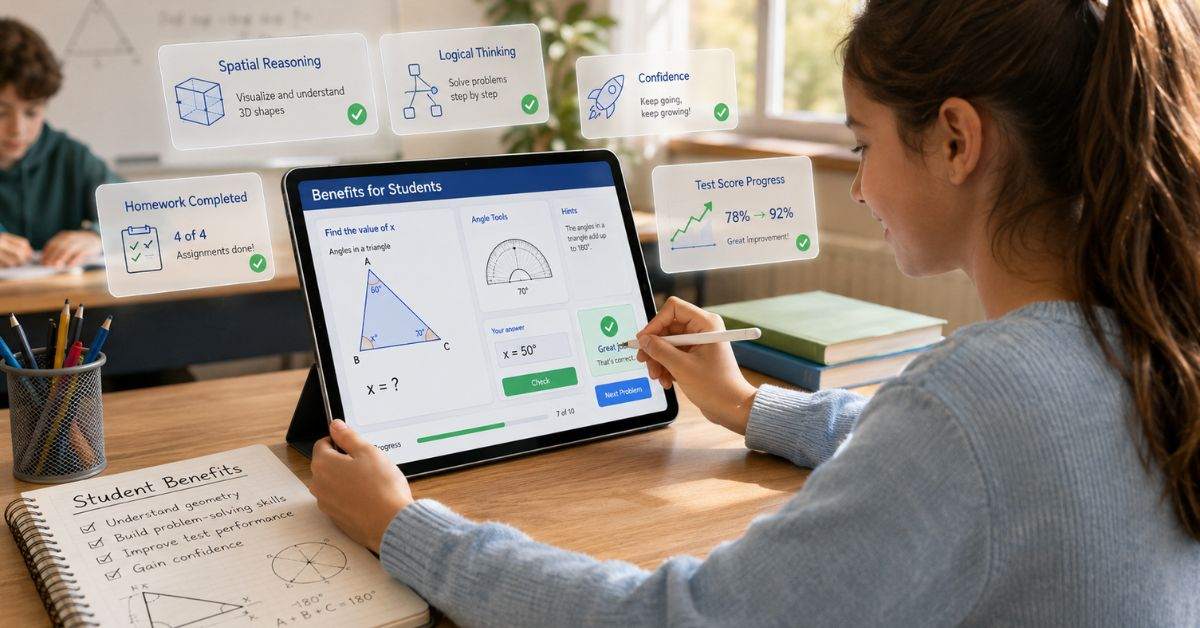
Students benefit academically and cognitively from using Geometry Learn V3. The interactive environment reduces confusion around abstract topics and increases engagement.
Key student benefits include
- Improved spatial reasoning
- Stronger logical thinking skills
- Higher confidence in solving complex problems
- Reduced math anxiety through guided hints
- Greater retention of geometric concepts
Case Study: Middle School Implementation
A school district implemented Geometry Learn V3 for one academic year and reported the following results:
| Metric | Before V3 | After V3 |
| Average Test Score | 74% | 89% |
| Homework Completion | 68% | 92% |
| Engagement Surveys | Moderate | High |
The students said that interactive images helped them “see” how shapes fit together. Teachers noticed increased participation and persistence during problem-solving activities.
These measurable improvements demonstrate how Geometry Learn V3 enhances both understanding and motivation.
Advantages for Teachers and Schools
Geometry Learn V3 also supports educators by streamlining instruction and providing actionable insights. Teachers gain access to the following:
- Real-time analytics dashboards
- Automated grading systems
- Curriculum-aligned lesson modules
- Differentiated learning pathways
Schools benefit from scalable digital integration. The system works effectively in traditional, blended, or remote learning environments.
Instead of spending hours grading assignments, teachers can focus on mentoring students and facilitating discussions about geometric reasoning. Data-driven insights allow administrators to evaluate performance trends and make informed decisions.
This combination of efficiency and academic rigor makes Geometry Learn V3 a practical investment for modern institutions.
Supporting STEM Readiness
Geometry is foundational for careers in engineering, architecture, robotics, and computer graphics. Spatial reasoning skills developed through geometry directly impact STEM performance. Geometry Learn V3 strengthens STEM readiness by:
- Encouraging analytical problem-solving
- Integrating 3D modeling simulations
- Connecting geometric principles to real-world design
- Supporting logical reasoning development
Students might simulate bridge designs, analyze symmetry in architecture, or explore coordinate-based navigation systems. These applied experiences help learners see geometry as a practical tool rather than an abstract subject.
Research consistently links strong spatial reasoning with success in technical fields. By emphasizing visualization and exploration, Geometry Learn V3 prepares students for future academic and career challenges.
Implementation Strategies for Schools
Adopting Geometry Learn V3 requires structured planning to maximize its impact. Effective implementation steps include:
- Conducting teacher training workshops
- Testing device and internet compatibility
- Aligning lessons with curriculum standards
- Starting with a pilot program before full rollout
Schools that introduce the platform gradually often achieve smoother transitions. Collecting data during early stages allows administrators to adjust pacing and instructional strategies.
Clear communication with educators and students ensures that the system becomes integrated into daily instruction rather than functioning as a supplemental add-on.
With thoughtful planning, Geometry Learn V3 can become a central component of a school’s mathematics program.
Geometry Learn V3 vs. Other Digital Programs
Many digital math platforms provide video lessons and quizzes, but not all offer interactive manipulation tools. Geometry Learn V3 distinguishes itself through:
- Real-time shape transformation capabilities
- Adaptive difficulty adjustments
- Comprehensive performance analytics
- Structured proof visualization tools
In contrast, some basic platforms rely primarily on passive instruction methods. Geometry Learn V3 emphasizes exploration and experimentation.
This interactive focus supports deeper conceptual understanding, which is critical for mastering advanced geometry topics.
Challenges and Limitations
Despite its advantages, Geometry Learn V3 may present certain challenges. Common considerations include:
- Reliable internet access requirements
- Initial training time for teachers
- Budget allocation for licensing
However, these challenges can be addressed through professional development programs and phased implementation strategies.
The Future of Geometry Learning Beyond V3
Geometry Learn V3 represents a significant milestone, but educational technology continues to advance. Future developments may include:
- Artificial intelligence tutoring systems
- Augmented reality geometry exploration
- Predictive analytics for early intervention
- Global collaborative virtual classrooms
These innovations will likely build upon the interactive foundation established by Geometry Learn V3.
As digital tools evolve, geometry education will become increasingly immersive and personalized. Geometry Learn V3 sets the stage for this transformation by prioritizing conceptual understanding, adaptability, and student engagement.
FAQs
What grade levels use Geometry Learn V3?
It is primarily designed for middle school and early high school students, though adaptable modules may support other levels.
Is Geometry Learn V3 aligned with academic standards?
Yes, it aligns with Common Core and international mathematics standards.
Can it be used for homeschooling?
Yes, its adaptive features and feedback tools make it effective for independent learning.
Does it replace traditional textbooks?
It can function as a primary curriculum or a supplementary digital resource.
How does it improve spatial reasoning?
By allowing students to manipulate shapes and explore transformations directly, strengthening visualization skills.
Conclusion
Geometry Learn V3 represents the modern evolution of geometry education. By integrating interactive modeling, adaptive assessments, and data-driven insights, it transforms how students understand shapes, angles, and spatial relationships.
Students gain deeper comprehension and improved confidence. Teachers benefit from streamlined instruction and actionable data. Schools acquire a scalable and future-ready learning solution aligned with STEM goals.
As education continues to embrace digital innovation, Geometry Learn V3 stands out as a comprehensive and forward-thinking curriculum model.